I loved Prague. I spent a week exploring this fabulous city, taking in the sites, but I admit I missed out a large part of Prague’s history on my visit – Prague’s Jewish history. When I had the chance to take a virtual tour of Prague’s Jewish Quarter with Czech Tourism and Prague City Adventures it was the perfect opportunity to learn more about the lives of Jewish People in Prague, in particular during the Second World War.
This blog post is sponsored by Czech Tourism, I had a complimentary virtual tour in exchange for this article.
Know Before You Go to Prague
Before travelling to Prague, make sure you book accommodation and popular attractions ASAP as hotels and tickets can sell out.
🛌 MY FAVOURITE ACCOMMODATION IN PRAGUE:
$$ Miss Sophie’s Downtown: Comfy, modern hotel next to the main train station
$$ Hotel Residence Green Lobster: Historic building close to Prague Castle
$ Onefam Home: highly rated and sociable hostel in the Old Town
⭐ TOP 3 PRAGUE ACTIVITIES TO BOOK IN ADVANCE:
1. Prague Castle Tour with Local Guide and Entry Ticket
2. Prague Old Town Hall & Astronomical Clock Entrance Ticket
Find Deals to Book Your Trip





A Prague Virtual Tour
Prior to the pandemic Prague City Adventures led in-person tours around the city, and now they have turned to virtual tours. I’ve done a few virtual tours during the pandemic, while I haven’t been able to travel in person, and this tour was definitely one of the best!
Our guide Nikola led us around the Jewish Quarter in Prague, live streaming on her phone while she explained the history and personal stories of Prague’s Jewish inhabitants. She focused on Jewish history in Prague during the Second World War, sharing facts about the atrocities Jewish people faced here, but also showing that through dark times there are still heroes and heroines – ordinary people who decided to take a stand.
If you’d like to take an in-person tour of the Jewish Quarter during your visit to Prague, check out this tour which includes entry tickets to several synagogues and the Jewish Cemetary:

Jewish History in Prague
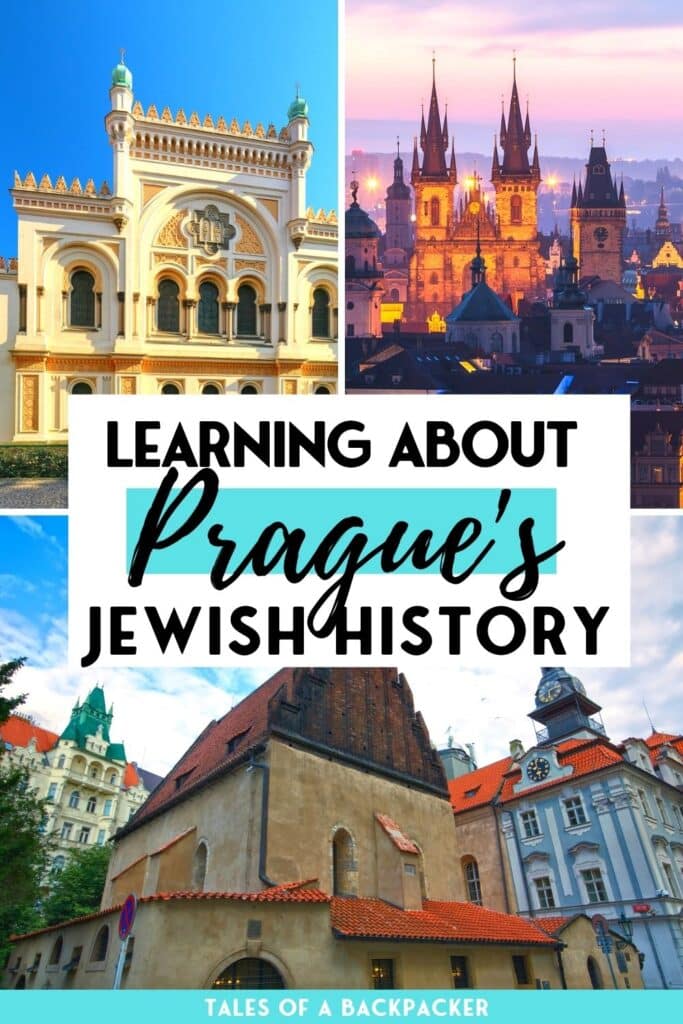
Prague’s Jewish Quarter is part of the city’s Old Town, and a relatively small part of Prague, but was at one time one of the most important Jewish communities due to the location of Prague being right in the centre of Europe.
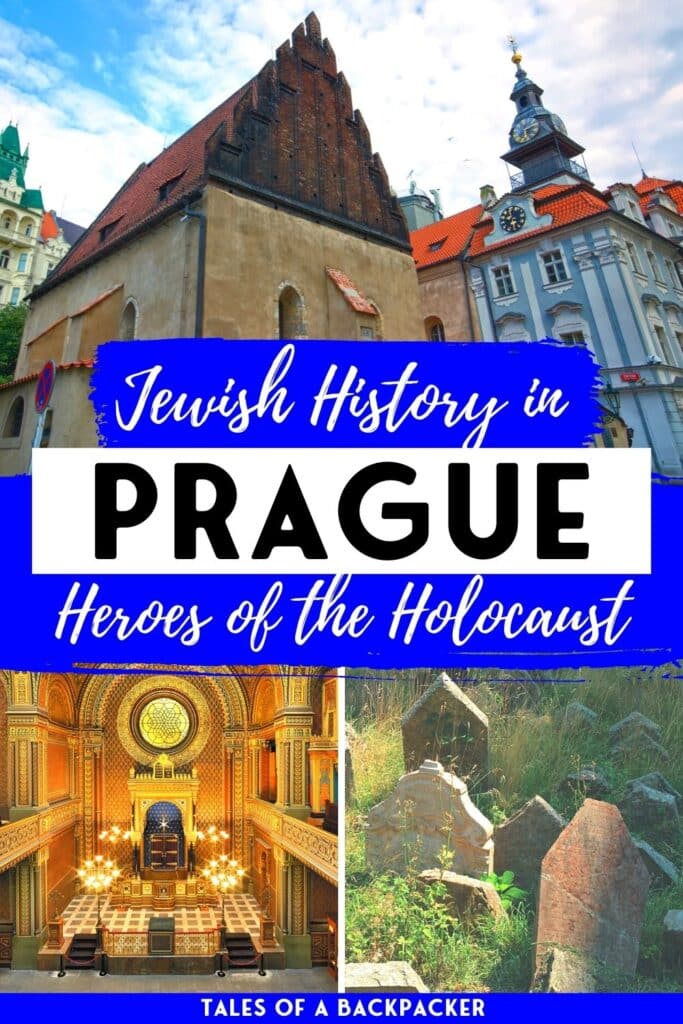
The first synagogue in Prague was built in 1270 and is known as the Old-New Synagogue. Originally called the New or Great Synagogue, when other synagogues were built in the city in the 16th century it came to be called the Old-New Synagogue.
YOU MAY ALSO LIKE: The Best Things to do in Prague in 2 Days
There are now six synagogues in Prague’s Jewish Quarter. The Pinkas Synagogue became a memorial to the victims of the holocaust. Its walls hold the longest epitaph in the world, which lists the names of those who died in the Nazi concentration camps – some 78,000 people from the Czech Republic alone.
The Maisel Synagogue was used as storage for anything of value during the war and is now a beautiful museum. The Maisel, Klaus and Spanish Synagogue are also wonderful examples of Jewish architecture, particularly the so-called Spanish Synagogue because of its Moorish influence and similarity to the Alhambra in Spain. The Jewish Town Hall is one of the symbols of the Prague ghetto, and has a picturesque little tower.

Much of the Jewish Quarter is preserved, in part because during the war, Hitler designated Prague as a “Museum of an Extinct Race” and collected and stored many Jewish items here from the families who were taken to concentration camps.
From 1939, Czechoslovakia (as it was then) was fully occupied by the Nazis. While there was still a Czechoslovakian President, he was really a puppet and had no proper control. Hitler formed the Protectorate of Bohemia and Moravia and had his own Reichsprotektor or governor who was really in control.
During this period, while so many Jewish people were sent to their deaths, there were stories of people who resisted, who did everything they could to save others and to make a stand against the Nazi regime. Nikola share a few of these stories with us.
YOU MAY ALSO LIKE: Why You Should Visit Prague in Winter
Some of the Heroes of the Holocaust
Friedl Dicker-Brandeis
Friedl Dicker-Brandeis was certainly one of the heroines of the Holocaust. Originally from Austria, she was an artist and educator who married a man from Prague, Pavel Brandeis. She received letter of invitation to Terezín, a concentration camp close to Prague, designed to collect Jews together in one place before being sent to extermination camps elsewhere.
She could only take with her 50kg of personal items and decided that she would take crayons, pencils and art supplies. She became a carer for children who were kept separate from their families and held secret art classes in the camp. She saw drawing and art as a way for the children to understand their emotions and their environment, a kind of art therapy. She collected over 4,500 paintings and drawings by the many children who passed through the camp.
In September 1944, her husband was transported to Auschwitz, and Friedl volunteered for the next transport so she could join him, not knowing what would await them there. Before she was taken away, she left two suitcases filled with the children’s drawings behind.
Friedl Dicker-Brandeis was murdered in Auschwitz on 9 October 1944. The suitcases of drawings survived, and now are displayed in an exhibition in the Maisel Synagogue. There were nearly 660 authors of the drawings, 550 of whom were killed during the Holocaust. Friedl’s collection serves as a legacy of the work she did to help the children of Terezín and a memorial to those who didn’t survive.

Nicholas Brinton
Nicholas Brinton was from Great Britain. In 1938 he was going to Switzerland on holiday but decided to go to Czechoslovakia instead. During that time, some parts of Czechoslovakia were already occupied by the Nazis, and people were fleeing. There were many refugees who had nowhere to go.
He wrote letters to all the embassies in Europe to try to get space for people from Czechoslovakia. Great Britain and Sweden agreed to accept some refugees, and Nicholas Brinton arranged all the papers and visas and a deposit fee of £50 for each child – a lot of money then!
YOU MAY ALSO LIKE: The Ultimate Prague Food Guide
From beginning of 1939 until September 1939 he saved 669 children who travelled by train to Great Britain to safety. He did have plan to save 250 more, but the last transport was planned for September 1st, the official start of war when the Nazis invaded Poland. They never arrived.
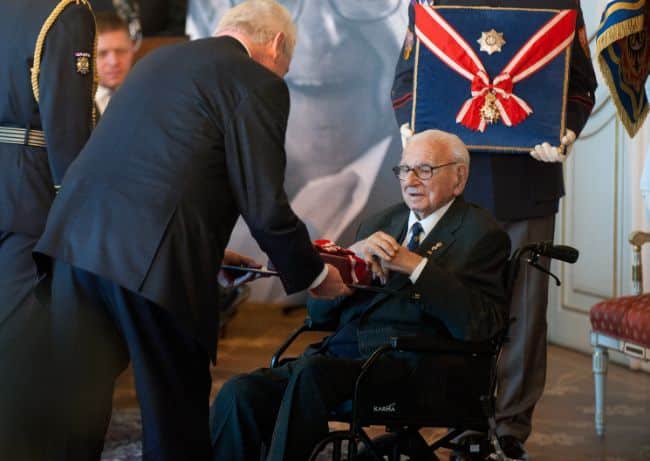
Nicholas Winton was a humble man and didn’t share his story as he believed that anyone would have done the same. In 1988 his wife was in the attic and found a box of papers and lists of names of all the children, finally understanding that her husband had something to do with saving them all.
The full story came to light when he was invited on the UK TV show That’s Life. You can watch a clip here, I defy anyone to watch this and not get a tear in your eye! In 2014, he was awarded the highest honour of the Czech Republic, the Order of the White Lion (1st class), by Czech President Miloš Zeman, and passed away his sleep in 2015, at the age of 106.
Jan Kubiš and Jozef Gabčík
There are homegrown heroes too, of course. Jan and Josef were two exiled Czechoslovakian soldiers who returned to the country to carry out a mission to assassinate the Reichsprotektor, a man by the name of Reinhardt Heydrich.
Heydrich was chief of the Reich Main Security Office (including the Gestapo) and a principal architect of the Holocaust, chairing the January 1942 conference which formalised plans for the “Final Solution”, the deportation and genocide of all Jews in German-occupied Europe.
As Reichsprotektor, a kind of governor over Bohemia and Moravia, he came to be known by many names, including The Hangman, the Man with Iron Fist and the Butcher of Prague which should tell you how he treated the people of Prague, in particular the Jewish people under his control.
Operation Anthropoid was the mission to assassinate him, carried out by several Czech paratroopers who were trained by the British Secret Service, including Jan Kubiš and Jozef Gabčík. After observing Heydrich’s routine, which he followed religiously, they attacked his car close to a bridge across the river from Prague Castle when he was on the way to his offices.
Jozef stepped in front of the car to shoot Heydrich, but the gun jammed. Then Jan threw a bomb at the car but didn’t manage to kill Heydrich right away. However, he was injured from shrapnel and was taken to hospital. In the end he died from blood poisoning due to horse hair entering his body from the car seat as it was pierced by the shrapnel.
The two men succeeded in the mission, but retribution by the Nazis was swift and violent. They destroyed two villages completely, the village of Lidice was razed and all the males over age 16 shot, and the children and women sent to concentration camps.
The paratroopers were hiding in Church of Sant Cyril in Prague when 800 SS troops descended on the church. They battled for hours without surrender, but all of the paratroopers, including Jan and Jozef were finally killed. There is now a museum in the church crypt dedicated to them as national heroes.
If you want to learn more about the story of Jan, Jozef and Operation Anthropoid, there have been several films made about them – the two most recent being Anthropoid and The Man with the Iron Heart.
Jewish History Remembered
I was struck by all of these stories of normal people becoming heroes and heroines during such terrible times. It wasn’t easy listening to the details of their lives, but it is so important to remember what happened during that time, to honour those who were killed, and to make sure that part of history never repeats itself.
YOU MAY ALSO LIKE: Visiting the Berlin Wall
All around Prague, look down at the pavement and you will find Stumbling Stones, engraved brass stones with inscriptions of people’s names who were murdered during the Holocaust. Nikola pointed out one where Max Eckstein was born, who was deported in 1941 to Lodz where he was murdered.

These reminders of people who were killed during the holocaust are the work of Gunter Demnig, an artist from Germany, realised that his father was a member of the SS and wanted to find a way to redeem his family name and to remember those who died. He decided to create these “Stolperstein” stumbling stones. There are around 75,000 of them around Europe, and you can find a list of the ones in the Jewish Quarter in Prague on Wikipedia.
According to Jewish tradition everyone dies twice. The first time is when the heart stops beating, and the second time is when the dead person’s name is spoken, read or thought of for the last time. With these Stumbling Stones, those who died will never be forgotten.
That’s also why tours like this one are so important. Learning about a destination, its history and its people is a vital part of travel, it is how we understand more about the world and ourselves. It wasn’t an easy tour to take, but an essential one. And when you go to Prague I highly recommend a tour of the Jewish Quarter, or at the very least watch where you are walking and look out for the Stumbling Stones so you can help preserve the memory of those lost during the Holocaust.
More Prague Travel Tips

Want to Read More About the Czech Republic?
Check out these other Prague blog posts for more information:
Getting There
- Use Skyscanner to find cheap flights to Prague from your nearest airport.
- You can take the public bus and metro into the city from the airport, but a private transfer or shared shuttle transfer is quicker and easier.
- Try Omio for booking trains or Flixbus for buses to Prague

Where to Stay in Prague
- Use Hostelworld to find the best prices for hostels in Prague.
- For hotels, check out Booking.com or Hotels.com for the best deals

Get Travel Insurance
- Unfortunately, things can and do go wrong when you travel. I never leave home without travel insurance, so consider getting insurance for your trip to cover things like adventure sports and activities as well as emergency medical, lost luggage, stolen items, trip cancellation and more.
- Get a quote for your trip from True Traveller if you're based in the UK, or World Nomads or SafetyWing which both offer travel insurance for backpackers and long-term travellers. Alternatively, use a comparison site like Travel Insurance Master to find the best cover for you.

Check Your Travel Documents
- Don't forget to check the validity of your passport and any other documents for your trip. Use iVisa to check if you need a visa to visit the Czech Republic and get up-to-date official travel advice from your government, such as the Department of State website in the US or the UK government website.

Get Cheap Currency
- Using a travel bank account like Wise means you get great deals on foreign currency - including a fee-free transfer of up to £500 when you use this link to sign up.

Book Tours and Activities in Prague
- If you're staying in a hostel, check out their tours and activities which are usually free or very cheap - and a great way to meet people!
- Otherwise, I use GetYourGuide to book everything from entry tickets to food tours.
- If you plan to visit a lot of museums and attractions, check out the Prague City Card which can work out as great value depending on what you want to do.
Like this post? Pin it to read later: